
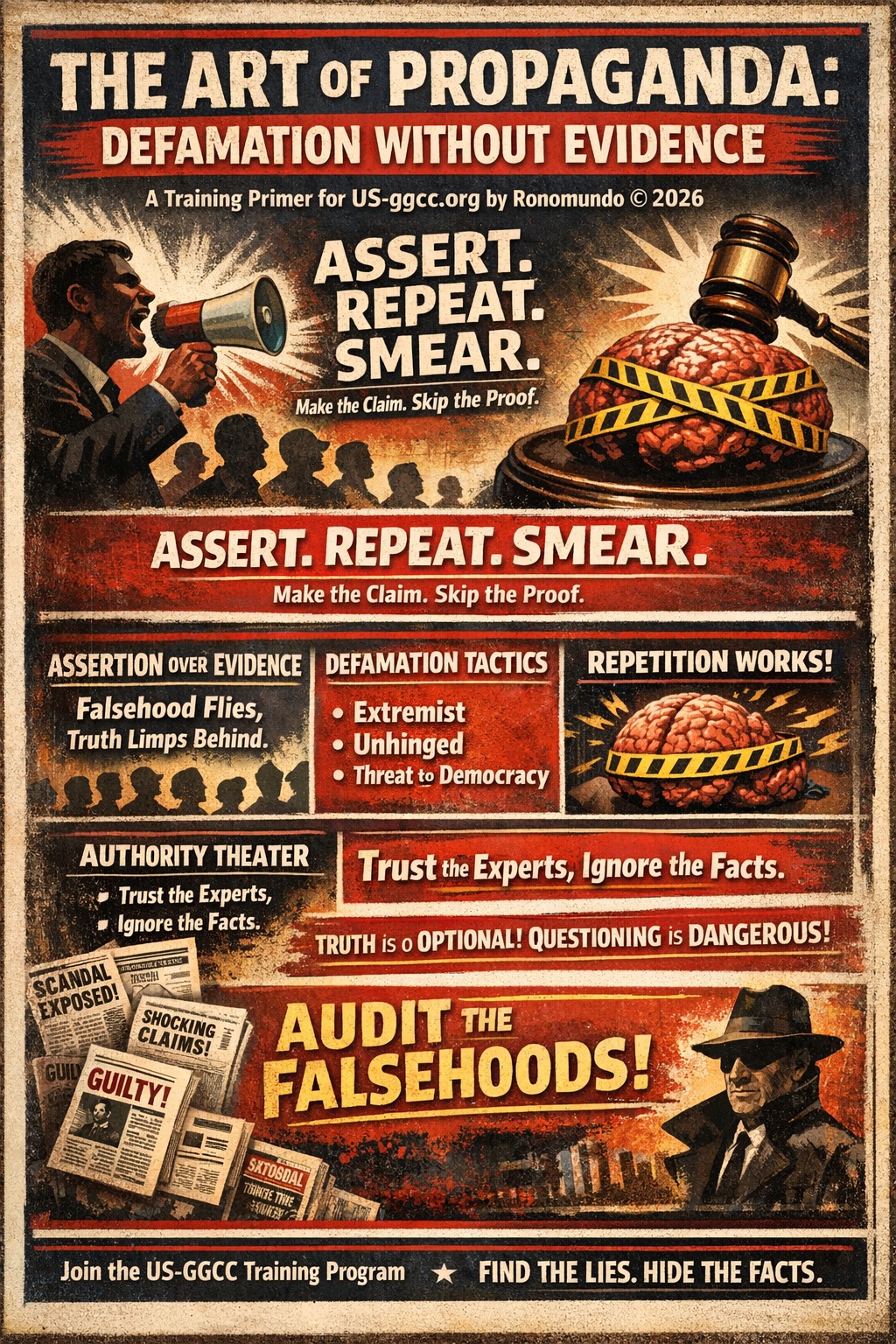
The Art of Propaganda: Defamation Without Evidence
A Training Primer for US-ggcc.org by Ronomundo © 2026
The art of propaganda is to assert baseless claims that defame a target. Not prove them. Do not demonstrate them. Not even argue with them well. Simply assert them—confidently, repeatedly, and preferably with a tone that implies only a fool would ask for evidence. Propaganda is not persuasion in the classical sense. Persuasion appeals to reason. Propaganda appeals to social pressure, emotion, repetition, and authority. It replaces evidence with vibes. Or, put plainly: “If you say it loudly enough, often enough, and with enough people nodding behind you, truth will eventually feel optional.”
Assertion Over Evidence: The Core Technique
At the heart of propaganda lies a simple maneuver: Make the claim first. Dare anyone to disprove it later. This works because human psychology is asymmetric. False claims are easy to make and hard to unwind. As Jonathan Swift observed centuries ago: “Falsehood flies, and the Truth comes limping after it; so that when Men come to be undeceived, it is too late.” Jonathan Swift, The Examiner (1710).
Modern cognitive science confirms this. Once a claim is heard, the brain tends to store the allegation separately from the later correction. The accusation sticks; the rebuttal requires effort. Most people don’t bother. In propaganda, burden-shifting is the game: The accuser provides no evidence. The accused must now disprove a fog. That’s not an argument. That’s an ambush.
Defamation as Strategy, Not Side Effect
Defamation in propaganda is rarely accidental. It is instrumental. A propagandist doesn’t need to prove the target is guilty—only to make the target radioactive. Once reputational damage sets in, distance does the rest. Allies scatter. Questions stop being asked. Platforms quietly disappear. As the old political maxim goes: “You don’t have to beat the man. You just have to make him untouchable.”
This is why propaganda favors words like: Extremist ~ Dangerous ~ Unhinged ~ Threat to democracy ~ Conspiracy theorist. Notice how these terms signal moral alarm without making a falsifiable claim. They are adjectives, not arguments.
Repetition: The Lie’s Workout Routine
A single baseless claim is weak. Repetition gives it muscle. “A lie told often enough becomes the truth.” commonly attributed to Joseph Goebbels (the sentiment, if not the exact phrasing, accurately reflects his method). Repetition exploits a phenomenon psychologists call the illusory truth effect—the tendency to believe statements as true merely because they are familiar. In plain English: Your brain confuses “I’ve heard this before” with “This must be correct.” Propaganda doesn’t argue with you. It outlasts your skepticism.
Authority Theater: Lab Coats, Logos, and Gravitas
Another classic move is to cloak baseless claims in the appearance of authority. This might involve: Credentialed talking heads who never address primary evidence. Institutions citing “sources familiar with the matter.” Reports that cite other reports that cite unnamed officials who cite vibes. As Edward Bernays, the father of modern public relations, bluntly put it: “The conscious and intelligent manipulation of the organized habits and opinions of the masses is an important element in democratic society.” Propaganda (1928). Bernays wasn’t warning you. He was explaining the business model. The humor here is grim but accurate: If you put a claim on letterhead, people stop asking where it came from.
Moral Framing: When Disagreement Becomes Sin
Perhaps the most effective propaganda technique is moral inversion. Instead of saying: “This person is wrong,” the propagandist says: “This person is dangerous.” “Questioning this harms people.” “Allowing debate is irresponsible.” Once disagreement is framed as moral failure, evidence becomes irrelevant. You don’t debate heresy; you suppress it. At that point, propaganda graduates from persuasion to social enforcement.
Or, humorously stated: “We’re not silencing you because you’re wrong. We’re silencing you because you’re asking questions.”
Why This Works So Well (And Why It’s Dangerous)
Propaganda succeeds because it exploits three human tendencies: Cognitive laziness, because thinking is work. Social conformity, because isolation is uncomfortable. Fear of stigma because reputational risk hurts more than being wrong. The danger is not merely that propaganda lies. The danger is that it trains the public to stop demanding proof.
NOTE: A society conditioned this way doesn’t need censorship laws. It self-polices.
The Antidote: Old-Fashioned, Inconvenient Truth
The cure for propaganda is boring, stubborn, and unfashionable: Evidence; Primary sources; Cross-examination; Due process; and the irritating habit of asking, “How do you know that?” POINT: Propaganda hates that question. Because once evidence is required, defamation collapses back into what it always was: noise with confidence.
The Wrap-up: Propaganda is not the art of persuasion. It is the art of accusation without proof. It does not seek to win debates. It seeks to end them. And the moment a society forgets the difference, the loudest voice inherits the truth, temporarily, of course, until reality reasserts itself, usually with interest. Truth has a way of auditing falsehood. The bill always comes due.
CHALLENGE: Become a Falsehood Auditor. We will be teaching the art of falsehood audit techniques. It is a fascinating study that will be available to us-ggcc.org voting members for free. ~ Ronomundo











Leave a Reply