
By Ronomundo © 2026
If policymakers decide to create legal pathways for long-term, law-abiding undocumented residents, the key is simple: Reward compliance. Protect labor markets. Preserve border enforcement credibility. Avoid repeating 1986. I do not yet have the markup text for any of these possibilities, or for a hybrid of them. They are working on a solution, but have not heard when the trial balloons will be launched. Below are visa concepts that could realistically function within that framework. The Trump people have been working on these for quite some time.
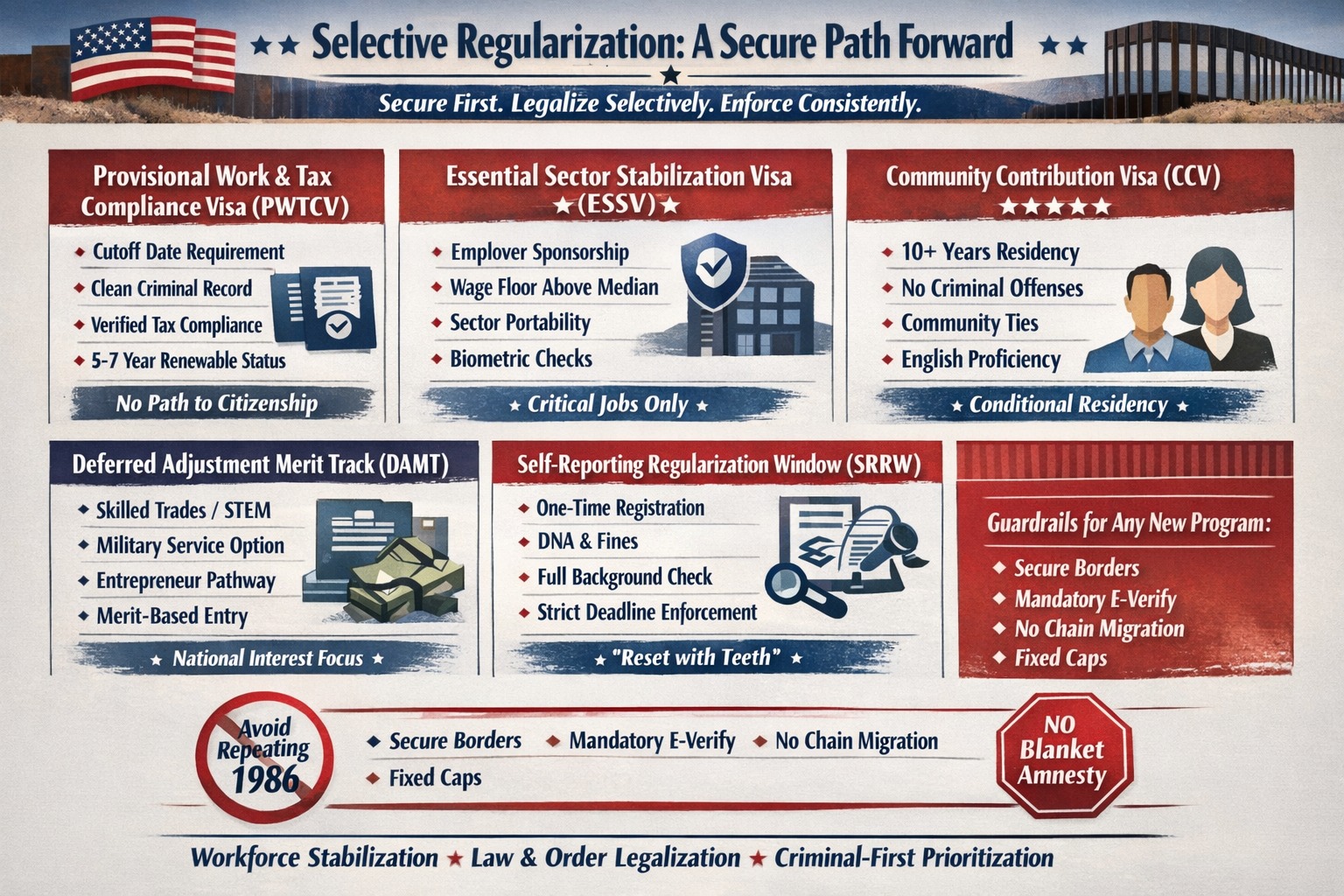
~ Provisional Work & Tax Compliance Visa (PWTCV) ~ Purpose: Regularize long-term, law-abiding workers already embedded in the U.S. economy.
Core Features: Available only to individuals physically present before a fixed cutoff date. Clean criminal record (no felonies, no violent misdemeanors). Verified tax compliance (past and future). Mandatory E-Verify participation by employers. 5–7 year renewable status. No immediate path to citizenship (to avoid “amnesty” optics). Adjustability to a green card only through existing employment-based channels.
Why it could work: It converts underground labor into taxed labor while maintaining enforcement credibility.
~ Essential Sector Stabilization Visa (ESSV) ~ Purpose: Address chronic shortages in agriculture, construction, food processing, elder care, and similar sectors. Core Features: Employer sponsorship required. Wage floor above local median to prevent labor suppression. Portability (the worker can change employers within approved sectors). Annual labor audit triggers to prevent abuse. Mandatory biometric registration.
Why it could work: Stabilizes industries that quietly depend on undocumented labor while discouraging under-the-table hiring.
~ Community Contribution Visa (CCV) ~ Purpose: Reward long-term integration and civic stability. Eligibility: 10+ years of continuous presence. No public safety violations. Demonstrated community ties (churches, nonprofits, schools, business ownership). English acquisition plan. Federal tax filing history.
Structure: 10-year conditional residency. Ineligible for most federal benefits. Revocable upon criminal offense.
Why it could work: Targets deeply rooted families without incentivizing new unlawful entry. Would face significant resistance from Democrats.
~ Deferred Adjustment Merit Track (DAMT) ~ Purpose: Channel high-skill, military-eligible, or trade-certified individuals into lawful status. Tracks Might Include: Skilled trades certification (electricians, welders, HVAC). Military service pathway. STEM employment. Entrepreneurship (minimum capital + job creation). Highly favored by foreigners who are providing input.
Why it could work: Aligns legalization with national interest rather than broad humanitarian framing.
~ Self-Reporting Regularization Window (SRRW) ~ A short, one-time registration window: Biometric enrollment with DNA profile. Civil penalty payment. Background check. Immediate work authorization. Strict enforcement surges after the window closes. This mirrors the concept of a “reset with teeth.” It would also be viciously attacked by Democrats.
Guardrails That Would Be Politically Necessary ~ To survive congressional scrutiny, any new visa class would likely require: Hard border metrics first (measurable reduction in unlawful crossings). Mandatory E-Verify nationwide. No chain migration expansion. Strict bars for gang affiliation or identity fraud. Clear sunset clauses. Numerical caps or labor-market triggers.
Without enforcement credibility, reform collapses.
What Would Not Work ~ Open-ended amnesty with automatic citizenship. No cutoff date. No labor market protections. No enforcement back-end. That model destroyed trust after the Immigration Reform and Control Act of 1986 failed to deliver sustained enforcement.
Political Reality: Republicans attempting a “stage two” recalibration would likely frame these visas as “workforce stabilization.” National interest regularization. Law-and-order legalization. Criminal-first removal prioritization.
The pivot is not toward open borders; it is toward selective regularization while preserving enforcement optics. In short: Secure first. Legalize selectively. Enforce consistently. Cap future flows. If reform does not reduce incentives for new unlawful entry, it will repeat history. If it does, it could reset the labor market and political coalition simultaneously. And that, frankly, is the strategic tightrope.
Dr Bartels












Leave a Reply