
By @Ronomundo
The Illegal Alien Invasion Blueprint the Marxists Used for the Biden Administration Invasion Designed to overthrow our Republic
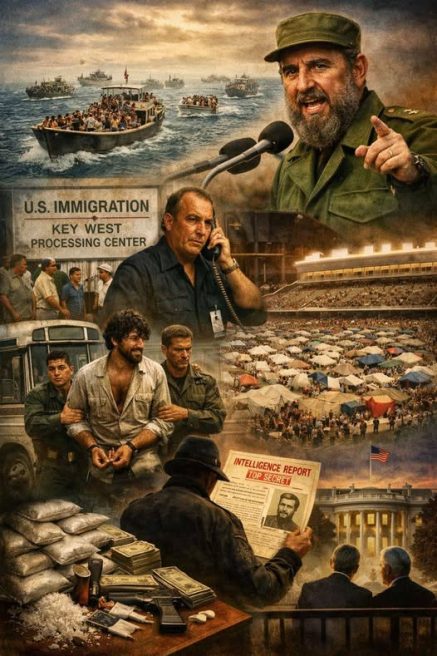
In April 1980, amid mounting unrest in Cuba, Fidel Castro made a fateful announcement in Granma, the Cuban Communist Party’s official newspaper. Cuban exiles in the United States were invited to sail to Cuba and collect anyone who wished to leave. At the same time, officials from Cuba’s Ministry of the Interior fanned out to prisons and detention facilities with a blunt ultimatum: leave the country—or remain incarcerated.
The response was swift. By April 24, roughly 1,000 boats departed Florida. Within a month, about 75,000 Cubans had arrived in the United States; by late September, the total reached approximately 125,000. Many Americans who participated believed they were joining a humanitarian rescue. Federal officials on the ground soon realized something far more complicated was unfolding.
One of them was Mariano Faget, a federal immigration officer dispatched to Key West. After observing early arrivals, he contacted the White House to warn that the migrant composition was unlike that of previous Cuban waves. His concerns were brushed aside as alarmist. Over time, however, evidence mounted that some migrants had been drawn directly from prisons, psychiatric institutions, or rounded up off the streets and compelled to leave.
Subsequent intelligence reporting—some of it circulating inside U.S. agencies but initially discounted—indicated that Havana had deliberately mixed violent criminals and mentally unstable individuals into the flow. Cuban intelligence sources warned Miami authorities that Castro intended to “launch a major offensive” against the United States using migration as leverage. A memo outlining those concerns was sent to the State Department, the FBI, and the CIA. The response: insufficient proof.
That memo traced back to Genaro Pérez, a former Cuban intelligence officer then assisting the Miami Police Department. Within weeks, troubling signs emerged: cases of tuberculosis, hepatitis, and severe psychiatric illness; later, confirmed criminal histories among some arrivals. Estimates at the time suggested that roughly 16,000–20,000 convicted criminals had been seeded into the exodus. Years later, hundreds of Mariel entrants remained in Dade County jails on any given day.
The public-safety consequences were real and measurable. Miami experienced sharp increases in violent crime as the population absorbed a group that had not undergone normal screening. Academic analyses later concluded that, given its composition and speed, Mariel represented one of the most disruptive migration events for local public safety in U.S. history.
Evidence also surfaced that Cuban intelligence had embedded operatives within the migrant flow. One such case involved Armando Romero Rivas, allegedly linked to Cuban biological-warfare planning. Recognized by a fellow refugee, Rivas was detained by U.S. authorities and later vanished from custody under unclear circumstances. U.S. assessments at the time estimated that thousands of intelligence assets—and hundreds of additional operatives tied to narcotics distribution—entered under refugee cover, contributing both to social destabilization and illicit revenue streams.
As reception centers overflowed—refugees housed temporarily in the Orange Bowl stadium or dropped at city streets—the nature of the crisis became undeniable. Senior U.S. officials began to acknowledge that migration itself had been weaponized. Jack Watson described the tactic starkly: people used “like bullets aimed at this country.” Victor Palmieri, overseeing refugee affairs, called it “a form of guerrilla warfare.”
The National Guard was eventually deployed, but by then, the United States was in damage-control mode. Jimmy Carter’s administration negotiated with Havana to halt the flow and sought—unsuccessfully at first—the return of criminals embedded in the exodus. Contemporary reporting captured Washington’s frustration: Cuba refused to take them back, leaving the U.S. to house individuals who, by any reasonable measure, belonged in Cuban prisons, not American communities.
Castro, by contrast, was openly pleased. He had demonstrated that mass migration could coerce a superpower. A later Department of Defense assessment concluded that he “revelled in the inability of the United States to control its border.” The lesson did not end in 1980. At regional gatherings—such as his 1980 visit to Nicaragua, celebrating the Sandinista takeover—Castro openly discussed the strategic leverage migration created, cultivating relationships with future leaders who took careful note.
The Mariel Boatlift ended after concessions and negotiations, but its strategic legacy endured. It proved that migration could function as a munition—producing economic strain, social disorder, and political leverage without a conventional shot being fired. Washington’s initial misreading forced it into the extraordinary position of asking Havana for relief from a crisis Havana had engineered.
Castro was not the last to learn this lesson. His successors and ideological allies would refine the tactic—sometimes with broader ambitions than mere disruption, aiming instead at long-term political and cultural transformation. Unlike 1980, those later efforts would find sympathizers and enablers inside the United States itself.
The Mariel Boatlift is often remembered as a humanitarian drama. It was that—but it was also something else: a case study in how migration can be deliberately manipulated as a strategic weapon. Forgetting that distinction is not compassion. It’s complacency—and history has already shown the price.
By Dr Ron Bartels


Leave a Reply